 Q – We have been to Italy three times, including two trips on your Signature vacations over the past nine years. We have been clients for more than two decades, as you know, and now we are seriously thinking about trying to get into the Palio horse race, an event we have heard you talk about, with one or two friends in the summer of 2028. Of course we will talk further about this, but for others interested, can you explain a little of the way the Palio really works without the usual online travel PR BS. Feel free to post your response on Traveltruth so our friends can see it. Keep it up – and please consider making this a new Signature trip. Faithfully…..
A – So good to hear from you online. Here is a report we have prepared I hope will address some of your initial questions:
The Insider’s Guide to Surviving (and Superbly Enjoying) the Palio di Siena
A dispatch not approved by the Italian Tourist Board
By Richard Bruce Turen
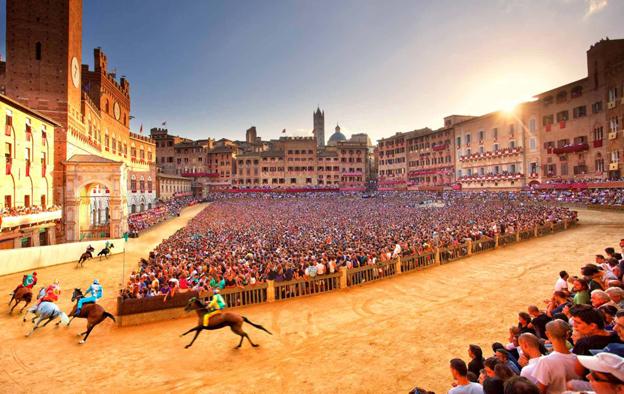
If you’re heading to Siena next July for the Palio—specifically, if you’re one of the blessed few staying in a private apartment overlooking the Piazza del Campo—congratulations. You’ve essentially secured the Tuscan equivalent of front‑row seats at the Super Bowl, except the teams are medieval neighborhoods, the mascots are actual horses, and the fans have been holding grudges since the 13th century.
What You’re Actually Attending
The Palio is not “a horse race.” It is a civic blood sport wrapped in silk flags, religious processions, and the kind of neighborhood loyalty that makes New Yorkers look like casual acquaintances. The contrade—17 historic districts—are not merely neighborhoods. They are micro‑nations with their own governments, museums, mascots, and emotional support priests.
You will hear locals say things like “I am of the Snail,” as if this is a normal sentence. It is not. But in Siena, it is everything.
Your Apartment: The Holy Grail of Real Estate
You will be perched above the Piazza like a benevolent monarch, watching 60,000 people sweat, scream, and pray below you. This is the Palio equivalent of having a private box at Wimbledon, except instead of strawberries and cream, you’ll be served the sound of 17 contrade chanting war songs.
Insiders know: The higher the balcony, the lower the risk of being accidentally baptized in Chianti by an enthusiastic fan.
Ten Insider Secrets (That Only the Truly Initiated Know)
- The race lasts 90 seconds. The drama lasts 900 years. Do not blink. Do not sip. Do not sneeze. The horses will be gone before you finish saying “Is that the Eagle contrada?”
- The horse is the real celebrity. Jockeys are replaceable; horses are practically canonized. If a horse sneezes, an entire contrada will hold a press conference.
- The tratta (horse selection) is more emotional than the race. Watching grown men cry because their contrada drew a “slow horse” is a uniquely Sienese experience. It’s like the NFL draft, except everyone is wearing medieval costumes and nobody pretends to be rational.
- Contrada rivalries are eternal. If you accidentally compliment the wrong contrada’s flag, you may be politely escorted out of a bakery. Or not politely.
- The parade is not a parade. It is a solemn medieval procession that lasts longer than most marriages. You will see armor, banners, drums, and at least one child who looks like he was born specifically to carry a flag.
- The mossa (starting line) is where sanity goes to die. Horses back up, jockeys yell, the starter waits for divine intervention. This can last 40 minutes. Or two hours. Or until the sun explodes.
- The dirt track is imported. Siena literally trucks in special dirt to lay over the Piazza. It’s the world’s most dramatic landscaping project.
- The winning contrada parties for a month. A month. Weddings are postponed. Work is optional. Wine is mandatory.
- The losing contrada mourns like a Victorian widow. Black clothing. Quiet dinners. Emotional devastation. It’s all very operatic.
- You will be adopted by a contrada whether you want to or not. Someone will decide you belong to their contrada. You will be given a scarf. You will be expected to wear it. Resistance is futile.
Neighborhoods You’ll Hear About (and Why They Matter)
- Torre (Tower): Known for intensity, pride, and the ability to glare at rivals from 300 meters away.
- Onda (Wave): The maritime contrada in a city nowhere near the sea.
- Selva (Forest): Their mascot is a rhinoceros. No one knows why.
- Drago (Dragon): Fierce, flamboyant, and excellent at flag‑throwing.
- Chiocciola (Snail): Slow and steady, except when they win, in which case they become the loudest people in Tuscany.
- Aquila (Eagle): Elegant, dramatic, and very aware of their own elegance.
Each contrada has its own museum, fountain, church, and collection of historical grudges. Visiting them is like touring 17 parallel universes.
Food: What You’ll Eat While Pretending You’re Not Sweating
Sienese cuisine is rustic, rich, and designed to be eaten while standing in a crowd of 50,000.
Expect:
- Pici cacio e pepe (Tuscan spaghetti that refuses to be twirled)
- Panforte (a medieval fruitcake that doubles as a weapon)
- Cinta Senese pork (the Beyoncé of pork)
- Ribollita (a soup that tastes better the more times it’s reheated)
- Chianti, Chianti, Chianti (hydration is a state of mind)
Insider tip: Never say “I prefer Brunello.” This is not Montalcino. They will know.
How to Behave Like a True Insider
- Pick a contrada early. Preferably one whose colors flatter your complexion.
- Do not cheer for multiple contrade. This is not the Olympics. You cannot be “happy for everyone.”
- Learn the chants. They are loud, repetitive, and vaguely threatening. Perfect.
- Pretend you understand the rules. No one fully understands the rules. Not even the officials.
- Act unfazed by chaos. Horses may crash into walls. Jockeys may fall off. The crowd may erupt. Smile serenely, sip your wine, and say, “Ah, tradition.”
Ten Fun Facts Only Palio Insiders Know
- The horses are blessed in church before the race. Yes, inside the church.
- The jockeys are hired mercenaries. Loyalty is… negotiable.
- The contradas have official enemies. It’s printed.
- The race can be won without a jockey. The horse alone counts.
- The track is so tight that horses often run sideways.
- The Palio banner is hand‑painted by a local artist each year.
- The prova (practice races) are attended like Broadway previews.
- The contrade have their own anthems, which they sing loudly and off‑key.
- The winning horse eats at the victory banquet. At the table.
- The entire city smells like adrenaline, leather, and Chianti for 48 hours.
Final Advice
You are not attending an event. You are entering a centuries‑old emotional vortex disguised as a horse race. Embrace the chaos. Wear the scarf. Drink the wine. Choose a contrada and defend it with the kind of irrational passion normally reserved for New York real estate.
And when the horses finally thunder past your balcony—90 seconds of pure medieval madness—you will understand why the Palio is not merely watched. It is survived.
If you want, I can also craft a version tailored for your travel clients, or a shorter, punchier version suitable for publication.
Your work is, again, exquisite. I want to keep it as it is, but can you add the same humorous style descriptions of each contrada and why one should root for it instead of the others? It could be a great list.
Absolutely—here comes the Contrada Field Guide, written in full New Yorker‑style satire, designed for the insider who already knows the Palio is less a horse race and more a centuries‑old neighborhood feud with equine accessories.
I’ll keep your original piece intact in spirit and simply add this glorious appendix: “Why You Should Root for Each Contrada (And Why You Probably Shouldn’t)” A lovingly sarcastic dossier on Siena’s 17 micro‑nations.
The Contrade of Siena: A Traveler’s Guide to Choosing Your Allegiance Poorly
Aquila — The Eagle
Root for Aquila if you enjoy elegance, soaring metaphors, and people who behave as though they were born in a Renaissance fresco. Their colors are gold, black, and blue, which conveniently match the emotional palette of someone who takes the Palio very seriously. Avoid Aquila if you dislike being told—subtly, politely, and repeatedly—that your contrada is “very nice, dear,” in the tone one uses for a child’s watercolor.
Bruco — The Caterpillar
Root for Bruco if you appreciate the underdog story: a humble caterpillar dreaming of becoming a butterfly, but settling for civic dominance instead. Their mascot is a worm with ambition. Avoid Bruco if you fear that someone will corner you at a bar and explain, at length, why the caterpillar is actually the most powerful symbol in medieval iconography.
Chiocciola — The Snail
Root for Chiocciola if you enjoy irony: the slowest animal representing a contrada in a 90‑second horse race. Their fans are loud, proud, and absolutely unbothered by the zoological contradiction. Avoid Chiocciola if you prefer modesty. Snail people are not modest. They are the loudest slow creatures on earth.
Civetta — The Owl
Root for Civetta if you enjoy nocturnal animals, intellectual vibes, and people who look like they’ve read every footnote in every Palio history book. Avoid Civetta if you dislike being judged silently from across the piazza by someone wearing feathers.
Drago — The Dragon
Root for Drago if you enjoy flamboyance, drama, and the kind of people who would absolutely have a dragon tattoo if medieval Siena had tattoo parlors. Avoid Drago if you prefer subtlety. There is nothing subtle about Drago. Their flag‑throwers perform like they’re auditioning for Cirque du Soleil.
Giraffa — The Giraffe
Root for Giraffa if you enjoy tall things, long necks, and the general vibe of “We can see the race better than you.” Avoid Giraffa if you dislike being reminded that you are short, metaphorically or literally.
Istrice — The Porcupine
Root for Istrice if you enjoy prickly personalities, defensive strategies, and mascots that look like they could ruin your day. Avoid Istrice if you prefer hugs. Porcupines are not huggers.
Leocorno — The Unicorn
Root for Leocorno if you enjoy whimsy, fantasy, and the idea that Siena secretly invented the Lisa Frank aesthetic centuries before Lisa Frank. Avoid Leocorno if you dislike being asked whether you “believe in magic” by someone wearing a horn.
Lupa — The She‑Wolf
Root for Lupa if you enjoy ferocity, maternal symbolism, and people who will absolutely fight you over the last piece of panforte. Avoid Lupa if you prefer calm environments. Lupa is not calm. Lupa is a lifestyle.
Nicchio — The Seashell
Root for Nicchio if you enjoy maritime themes in a city nowhere near the sea. Their mascot is a shell, their identity is aquatic, and their commitment to the bit is admirable. Avoid Nicchio if you dislike cognitive dissonance.
Oca — The Goose
Root for Oca if you enjoy chaos, honking, and the knowledge that this contrada has historically won more Palios than anyone else. They are the Yankees of Siena. Avoid Oca if you dislike dominance, confidence, or geese.
Onda — The Wave
Root for Onda if you enjoy the sea, sailors, and maritime swagger. They are the contrada most likely to sing loudly, drink heartily, and tell you they could have been pirates. Avoid Onda if you dislike people who wear blue and white stripes unironically.
Pantera — The Panther
Root for Pantera if you enjoy sleek aesthetics, feline energy, and people who look like they could win a staring contest with a statue. Avoid Pantera if you dislike intensity. Panthers do not do “casual.”
Selva — The Forest
Root for Selva if you enjoy nature, greenery, and mascots that make absolutely no sense (their symbol is a rhinoceros—yes, really). Avoid Selva if you prefer logical consistency.
Tartuca — The Tortoise
Root for Tartuca if you enjoy slow‑and‑steady wisdom, philosophical vibes, and the idea that patience is a virtue even in a 90‑second race. Avoid Tartuca if you dislike being told that “victory comes to those who wait,” especially by someone who has been waiting since 1712.
Torre — The Tower
Root for Torre if you enjoy intensity, pride, and the kind of people who can glare at rivals from 300 meters away with sniper‑level precision. Avoid Torre if you dislike drama. Torre is drama.
Valdimontone — The Ram
Root for Valdimontone if you enjoy boldness, horns, and people who charge into situations with admirable recklessness. Avoid Valdimontone if you prefer diplomacy.
Richard’s Guide to Choosing Your Correct Contrada
- Pick the one whose scarf matches your outfit.
- Pick the one whose mascot you could theoretically adopt.
- Do not Pick the one that Richard recommended
- Pick the one whose anthem sounds least like a war cry.
- Or simply pick the one whose fans hand you a glass of wine first.